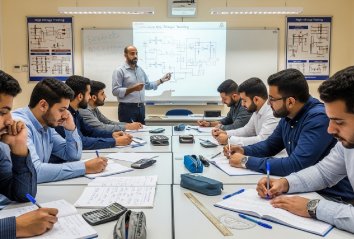
Overview
Master your skills in designing safe and efficient high voltage systems using modern software tools and techniques with the High Voltage Design Course from Engineering Design Qatar. The High Voltage Training Course provides the participants with comprehensive knowledge, practical training, and prepares them for a successful career in the power industry. Enroll now to have a powerful future.
Summary of High Voltage Design Course
The high voltage program equips the trainees with in-depth technical knowledge and practical skills essential for designing and implementing efficient high-voltage systems safely. The main objective of the high voltage classes is to provide a strong foundation in high voltage power systems, familiarize learners with international codes and safety standards, and brief them about the modern software and tools used for HV system design.
What will you learn in the high voltage technician training?
- Substation design and equipment selection
- Grounding system design
- Testing methods of high voltage testing
- International codes and standards
- Design of overhead transmission lines and underground cables
In-depth Course Syllabus for High Voltage Certification Course
The high voltage certification course includes the following topics:
Have an overview of electrical power systems, including generation, transmission, and distribution.
Know the components of HV systems such as lines, substations, transformers, and switchgear.
Study the classification of voltage levels, the basics of AC and DC, and the importance of high voltage systems.
Have an overview of the power grid structure and network configurations.
Know the types of substations, such as AIS, GIS, hybrid, indoor, and outdoor. Study their key components and their purpose.
FUnderstand SLD development, equipment placement, space optimization, busbar arrangements, and planning for future expansion.
Learn about the factors to be followed for the selection of substation equipment, including circuit breakers, power transformers, isolators, earthing switches, and surge arresters.
Study the insulation levels, creepage distance, clearance design, switching overvoltage protection, and lightning protection.
Know the types of grounding, the purpose of earthing in HV systems, and the effects of grounding.
Understand the types of earthing systems, including plate earthing, rod earthing, grid earthing, chemical earthing, and strip earthing.
Learn about soil resistivity and the factors affecting soil resistivity, including moisture, temperature, and the type of soil.
Find out how to design a substation earthing grid and grid layout. Study the placement of earth electrodes and the configuration of the mesh.
Understand the types, working principle, and construction of power transformers. Learn about their selection criteria.
Know the types of circuit breakers, their purpose, operation, and selection.
Study the types, function, and operation of isolators and their interlocking mechanism.
Learn about current transformers, voltage transformers, their selection, and installation procedures.
Become familiar with busbars, insulators, and capacitors, and their selection criteria.
Have an overview of the types of tests, including routine, type, and special tests. Know the testing standards and procedures.
Learn about the high voltage generation methods, such as AC high voltage generation, DC voltage generation, and impulse voltage generation.
Find out how to measure high voltage and the methods used for measuring it.
Know the testing standards and safety, field testing and commissioning, and on-site testing procedures.
Practical training with case studies.
Know the types of maintenance, including preventive, predictive, corrective, and condition-based.
Find out how to maintain power transformers through routine inspection, oil testing, and the cooling system. Understand the common faults and troubleshooting.
Learn how to maintain circuit breakers and substation equipment. Study the maintenance of overhead lines and the grounding system.
Understand the maintenance of protection and control systems. Have an overview of safety practices and the standards to be followed.
Study the common causes of failures in high-voltage systems and the fault types, including short circuit, open circuit, overvoltage, thermal, and mechanical faults.
Understand the fault detection techniques and the step-by-step troubleshooting methods.
Find out how to troubleshoot the grounding system and protection systems.
Become familiar with the tools and instruments used and the safety precautions to be taken.
Essential Skills You Will Acquire
On completion of the high voltage technician training, you will attain the following skills:
- Ability to design substation layouts and earthing systems.
- Skills to prepare SLD and perform load flow analysis.
- Ability to select the right equipment.
- Knowledge of safety standards.
- Skills in maintenance and troubleshooting.
Software proficiency
- ETAP
- AutoCAD
- SCADA
- Dialux
- MS Excel
Tools & Software Included
The tools included in the HV electrician course are:
- Measurement tools like multimeters, clamp meters, earthing equipment, etc.
- Cable sizing tools for the right selection
- Protective and safety tools
- Grounding design tools for grid design
Software tools for
- Digital diagnostic
- AutoCAD for electrical drawings
- ETAP for power system analysis
- Dialux for substation design
Career Scope in HV Design Courses
Reasons to Pursue a Career in the HV Course
Professionals who have completed HV training are in high demand in the power sector. HV training courses provide the participants with the skills essential for modern power systems. Moreover, the HV course makes the trainees ready to face the real challenges of the industry. This gives them an edge over the others.
Industry Relevance and Job Opportunities
Key roles after completing the HV design course include HV technician, HV electrical engineer, testing engineer, substation designer, and commissioning engineer. The industries where you can find jobs are power generation, electrical utilities, the manufacturing sector, the renewable energy industry, the oil & gas industry, and the power distribution industry.
Who Can Enroll?
Professionals working in the electrical, power, and MEP industries can enroll in the high-voltage safety training course. It is also suitable for fresh graduates and diploma holders in electrical engineering who want to start their careers in the power industry. Site engineers, technicians, and supervisors who want to upgrade their skills can join the high voltage course in Qatar.
Why Choose Us?
We are a popular institute offering short-term technical courses such as Revit training, MEP design, electrical design training, and AutoCAD 3D course, to upgrade the skills of professionals. You should join our high voltage safety course because of:
- The comprehensive syllabus
- The dedicated trainers, providing theoretical and practical training
- Flexible classes, including weekend and online classes
- Career guidanc
- Internationally recognized certificate
Fill out the online application form and submit it. Contact the support team to clear your doubts.
FAQ
It is a specialized short-term course to provide the trainees with in-depth knowledge in the design, testing, maintenance, and operation of HV systems and components.
Professionals working in the electrical, power, and MEP industries, fresh graduates and diploma holders in electrical engineering, and site engineers, technicians, and supervisors who want to upgrade their skills can attend the course.
.
The topics covered in the course include substation design and equipment selection, grounding system design, testing methods of high voltage testing, international codes and standards, and design of overhead transmission lines and underground cables.
Yes, an internationally recognized certificate is provided upon completion of the high voltage training course to prove the skills gained and that you are industry-ready.
You should have a basic knowledge of the electrical sector and an understanding of voltage, current, and circuits, but you don’t need any previous experience. It is open to freshers also.
Ratings & Reviews
4.5
Rated 4.4 out of 5 Rating
Student Reviews
The training was very good. The trainers explained all concepts clearly. I was able to understand, even though I am a fresher.
I will rate this course as the best course among all the HV voltage training certificate courses. I am an MEP engineer. I wanted to specialize in substation design, and this course definitely helped me.
The course is highly recommended to anyone interested in HV systems, their design, testing, and maintenance.