Overview
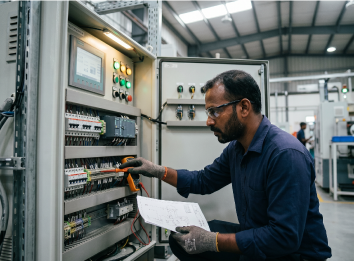
The control panel technician course from Engineering Design Qatar is designed to provide the participants with practical skills and technical knowledge in designing, maintaining, installing, wiring, and troubleshooting electrical panels in industries and commercial buildings. Master your skills in performing industrial wiring practices and understanding schematic drawings with our control panel training course.
Summary of Control Panel Training Course
The control panel course covers all aspects of electric power and circuits from fundamentals to advanced. The training provides the trainees with proficiency in designing and maintaining electrical systems needed for industrial automation. The control panel training course offers hands-on training in testing instruments, safety practices, diagnosing faults, and wiring methods.
What you’ll learn?
- Reading and interpretation of drawings and schematic diagrams
- The various components of control panels, their functions, and roles
- Practical skills in wiring and assembly of control panels
- Working of components like contactors, relays, timers, etc.
- Usage of testing instruments and measuring tools
- Electrical safety standards and safe practices
In-depth Course Syllabus for Control Panel Technician Certification Course
The syllabus of the control panel training course includes the following:
Have an overview of the electrical power system, its importance, and applications
Understand the various types of control panels, including PLC, PCC, VFD, MCC, and APFC.
Learn about the single-phase and three-phase systems, and AC and DC supply systems.
Become familiar with panel components, their accessories, electrical symbols, and terminologies.
Have an overview of the tools and testing instruments.
Understand the different types of electrical drawings, SLDs, and how to read them.
Study the power circuit and control circuit diagrams, and how to interpret schematic and wiring diagrams.
Learn about panel layout drawings, ladder diagrams, and component arrangement drawings.
Become familiar with GA drawings, earthing and grounding diagrams, and BMS control drawings.
Understand the types of electrical control panels and the usage of their components.
Study in detail about Miniature Circuit Breaker, Moulded Case Circuit Breaker, and protection devices, including RCCB and ELCB.
Learn about key components such as timers, counters, fuse holders, busbars, sensors, and field devices.
Become familiar with earthing and grounding components, industrial panel components, and how to select components
Understand the importance of panel spacing and arrangement, and the types of electrical control layouts.
Find out how to select and place electrical components, mount components, and plan panel door component layouts.
Learn how to select gland plates, segregate control sections, decide cable entry positions, and prepare GA drawings.
Study the terminal block arrangement methods, busbar arrangement, heat dissipation, and panel labeling.
Know the differences between layout, schematic, and wiring diagrams. Understand how to identify components in diagrams.
Learn about electrical symbols, electrical notations, wire numbering, and terminal markings.
Find out how to read power wiring and control wiring diagrams, and interpret single-phase and three-phase wiring diagrams.
Study VFD wiring, interlock wiring, field device wiring, panel wiring, relay wiring, and motor starter wiring diagrams.
Find out how to use testing tools and measuring instruments. Understand the techniques used for making voltage and current measurements.
Study control circuit testing, power circuit testing, and insulation resistance testing procedures and techniques.
Find out how to identify a short circuit and an open circuit. Learn about the preparation of documentation and test reports.
Find out how to identify short circuits, open circuits, and overload issues, and how to troubleshoot power and control circuits.
Learn how to find faults using electrical drawings and wiring diagrams, and troubleshoot using testing tools and multimeters
Understand the troubleshooting of protection devices, timers, control logic circuits, sensor devices, and PLC components.
Study the safety procedures to follow while troubleshooting
Have an overview of the industrial automation process.
Understand the basics of SCADA and HMI
Find out how to integrate control panels with automation systems.
Practical training in industrial automation.
Essential Skills You Will Acquire
Key Skills Gained
After completing control panel design training, you will acquire the following skills
- Assembly and wiring of control panels
- Panel layout design
- Safe handling of testing, troubleshooting, and assembling tools
- Skills in VFD installation
- Techniques for cable termination
- Reading and interpreting wiring diagrams
Software proficiency
- Basic PLC, HMI, and SCADA
- Software tools for reading and interpreting electrical drawings
Tools and Software Included
Trainees will get hands-on training in testing instruments, troubleshooting tools, software for assembly, etc. The tools included in the control panel wiring training course are:
- Multimeter
- Continuity tester
- Insulation tester
- Wire cutter
- Wire stripper
- Crimpers
- Screwdrivers
- Pliers
- Multimeters
- Clamp meters
- Phase testers
- Drills
- Impact drivers
- Safety gear
Software included is AutoCAD, PLC, SCADA, HMI, and EPLAN.
Software included is AutoCAD, PLC, SCADA, HMI, and EPLAN.
After completing the control panel wiring courses, participants have many career opportunities available to them.
Reasons to Pursue a Career in the Control Panel Technician Training
The demand for skilled control panel technicians is high in modern industries and residential buildings because of the rise in industrial automation and BMS. Moreover, they are assured of a stable and secure job with competitive salary prospects in a variety of sectors for the design, installation, maintenance, and troubleshooting of control panel systems.
Industry Relevance & Job Opportunities
After completing the control panel wiring courses, learners will be able to pursue several roles across diverse industries, including manufacturing, MEP, automation, power generation, oil & gas, and infrastructure. The roles include control panel technicians, field service technicians, BMS operators, PLC technicians, maintenance technicians, and SCADA technicians.
Who Can Enroll?
The course is for electricians, BMS technicians, HVAC technicians, and maintenance technicians who want to upgrade their knowledge in industrial automation. It is also for electrical, electronics, and mechanical engineers who want to enter the automation industry. Fresh graduates, diploma holders, and students interested in panel testing, troubleshooting, and wiring.
Why Choose Us?
Engineering Design Qatar is popular for its short-term technical courses designed for working professionals who want to upgrade their skills. You should choose us for electrical control panel design training because of:
- Comprehensive syllabus including hands-on training
- Trained and experienced faculty
- Flexible classes, including online and weekend classes to suit working professionals
- Career support and placement guidance
- Globally recognized certificate
The admission process is simple. Fill out the application form on the official website and submit it. If you have any doubts, contact the support team.
FAQ
It is a technical training course that provides theoretical and practical skills to the participants on installing, maintaining, testing, diagnosing, and troubleshooting electric control panels.
The course may last from a few days to few weeks depending on the syllabus, the institute, and the learning modes.
The monthly salary ranges from QAR 3000 to 5000 depending on the skills, experience, the company, and the type of project.
The job roles that this course can lead to are control panel technician, panel wiring technician, industrial electrician, BMS technician, and panel assembly technician.
Yes, it is available online. Some institutes offer live classes and others recorded sessions. Practical demonstrations are made and digital study materials are given.
The tools and equipment include multimeter, clamp meter, continuity meter, crimping tools, wire cutter, timers, etc.
Fill out the application form on the official website and submit it. If you have any doubts, contact the support team.
Ratings & Reviews
4.5
Rated 4 out of 5 Rating
Featured review
The course was very useful to me. After completing the electrical engineering course, I was able to get the much-needed hands-on training in control panel installation, maintenance, and troubleshooting.
I will recommend the course highly to anyone who wants to become an expert in industrial automation. The course gave me a career boost, thanks to Engineering Design Qatar.
I am an electrical technician. The course improved my skills. I was able to work in confidence in real projects with a lot of confidence.