Overview
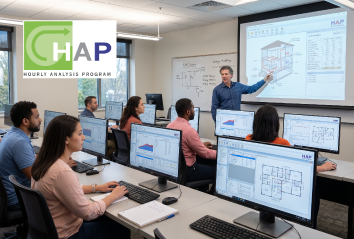
HAP course from Engineering Design Qatar is designed to provide skills in using Carrier’s software HAP to make accurate load calculations, equipment sizing, and psychrometric analysis. Designed for MEP engineers, MEP professionals, and students, HAP training will make the participants industry-ready and give them confidence in handling industrial challenges. Enroll in the HAP training course to gain practical skills in using HAP software.
Summary of HAP Training Course
The HAP software from Carrier is a powerful tool used for calculating heating and cooling loads, designing HVAC systems, and calculating energy costs. It is widely used by MEP engineers and HVAC professionals. The HAP analysis program is a perfect combination of theoretical concepts and practical exercises. It makes the candidates competent in making buildings energy-efficient.
What you’ll learn from HAP Training?
- Make load calculations and energy analysis.
- Set up a project and configure energy standards.
- Equipment sizing and selection
- Generating load calculation results
- Preparation of energy analysis results
- Application of the skills acquired in real construction and infrastructure projects
In-depth Course Syllabus for HAP Training Certification Course
HAP Training program syllabus includes the following topics.
Understand what HAP is, its features, benefits, and applications.
Have an overview of its workflow and the project setup and design process.
Learn about the basics of cooling and heating loads and the basic design standards.
Know the building envelope components, such as walls, roofs, doors, and windows, that affect the heating and cooling of a building.
Study the units and terminology of the software.
Have an overview of the ASHRAE load calculation method. Study how to collect and select weather data.
Understand the indoor design requirements and the comfort criteria. Learn about solar heat gain and its effects. Study the selection of construction materials..
Find out what building spaces and zones are and how to create floors, rooms, and thermal zones. Know the various building envelope outputs.
Become familiar with internal heat gain calculations, infiltration load calculations, and ventilation requirements.
Practical training in making heat load calculations.
Have an overview of the different cooling loads, including sensible, latent, and total.
Find out how to make a room-by-room cooling load analysis.
Understand the psychrometric analysis done for load calculations
Study how to interpret cooling load reports.
Practical sessions with case studies for residential and commercial buildings
Learn Energy Analysis Workflow in HAP. Have an overview of annual and hourly energy simulation, their features, and their differences.
Find out how to create energy analysis projects and build envelope and Geometry configuration. Know in detail about thermostat setpoints, usage profiles, control strategies, and internal heat gain modeling.
Understand how to create operating hours and occupancy schedules. Study the selection of HVAC systems for energy modeling.
Study how to evaluate part-load performance. Become familiar with the analysis of annual energy consumption, peak demand, utility bills, and life cycle costs.
Hands-on training in energy simulation and analysis for residential and commercial buildings
Find out how to create weekly, annual, occupancy, plug load, pump, fan, thermostat heating, cooling setpoint, and lighting operation schedules.
Learn how to create custom schedule profiles, assign schedules to building spaces, and apply them to HVAC systems.
Have an overview of the schedule, libraries and templates that can be reused.
Understand common errors in creating schedules and how to troubleshoot them.
Practical classes in the creation of schedules.
Understand the different types of HVAC systems such as CAV, FCU, VAV, AHU, and RTU. Have a basic understanding of air-cooled and water-cooled HVAC systems.
Learn about the selection criteria for HVAC systems and the assignment of zones to the HVAC systems.
Study how to design temperatures and setpoints, size HVAC equipment, and select chiller and boiler capacity
Know how to review the design, troubleshoot issues, and validate the design.
Have an overview of the main components, including DBT, WBT, and DPT. Become familiar with Relative Humidity and Specific humidity.
Find out how to plot the air conditioning points, calculate ventilation air, and analyze indoor comfort.
Learn how to use psychrometric charts for HVAC design.
Practical training in psychrometric chart analysis.
Essential Skills You Will Acquire
Key Skills Gained
After completing HAP classes, you will gain the following key skills:
- Calculating heat and cooling loads
- Designing energy-efficient HVAC systems
- Analysing psychrometric charts
- Analyzing energy performances
- Generating reports for energy analysis and performance
- Applying ASHRAE standards
Software proficiency
With HAP software training, you will gain expertise in
- HAP for load calculations
- Duct sizer for sizing ducts
- Pipe sizer for sizing pipes
Tools and Software Included
HAP software certification includes the following tools and software:
- Carrier HAP to make HVAC load calculations.
- AutoCAD for the initial steps like 2D floor plans
- Revit MEP for 3D modeling
- Duct Sizer for sizing ductwork
- Pipe Sizer for sizing piping and calculation of fluid pressure
Career Scope in HAP Training Course
Reasons to Pursue a Career in the HAP Certification Course
Energy efficiency is gaining a lot of importance globally. As the HAP software certification course equips the participants with skills in designing energy-efficient buildings, the course is in huge demand. It gives a competitive edge to the trainees over others in the job market. The candidates will get better salaries and job security.
Industry Relevance and Job Opportunities
After completing the Carrier HAP training, you can pursue several roles such as energy analysts, HVAC designers, MEP engineers, BIM modelers, project engineers, mechanical design engineers, building services engineers, commissioning engineers, HVAC consultants, and site engineers. You can get these roles in the construction of residential, commercial, and industrial buildings.
Who Can Enroll?
The HAP program is suitable for professional mechanical, electrical, and civil engineers and architects who want to upgrade their knowledge in HVAC design and heating and cooling load calculations. Fresh graduates, diploma holders, and students looking to gain practical skills can also join the HAP certification course.
Why Choose Us?
Engineering Design Qatar is famous for its short-term technical courses designed to upgrade the skills of working professionals. You should join our Carrier HAP software program because of the following:
- Comprehensive syllabus
- Flexible classes
- Expert trainers
- Career support
- Globally recognized certificate
The admission process is simple and hassle-free. Fill out the online application form and submit it with the essential documents. You can contact the support team 24/7 for any queries.
Enroll NOW to master your skills in HVAC design and gain confidence in working on real-world projects.
FAQ
A HAP course teaches the participants how to use Carrier's HAP software to design HVAC systems and make heat load calculations.
The course is used for energy analysis, determining heating and cooling loads, equipment sizing, equipment selection, creating energy-efficient designs, and compliance with standards.
You will learn to make load calculations, perform energy analysis, set up a project, configure energy standards, size equipment, generate reports, and prepare energy analysis results.
It is suitable for professional mechanical, electrical, and civil engineers, architects, fresh graduates, diploma holders, and students looking to gain practical skills.
The main concepts covered are ductwork design, psychrometrics, heat load calculations, cooling load calculations, energy analysis, HVAC design, and thermodynamics.
It is important for HVAC engineers because it helps in making load calculations precisely, ensures energy optimization, and helps in selecting the right equipment.
There are no strict prerequisites for joining HAP software classes, but basic knowledge of engineering and computers will be of great help.
Ratings & Reviews
4.5
Rated 4.2 out of 5 Rating
Featured review
HAP training from Engineering Design Qatar is a splendid course for anyone who wants to work on HVAC design projects. The trainers explained the concepts clearly, which helped me to understand all of them.
I am a fresh civil engineering student. The course provided me with the hands-on training I was waiting for. I am happy that I enrolled in this course. I would recommend it to my friends too.
There is no doubt that it is one of the best HAP programs. The all-inclusive syllabus and case-study-based practical training were the best. I was able to handle complex projects with lots of ease after completing the course.