Overview
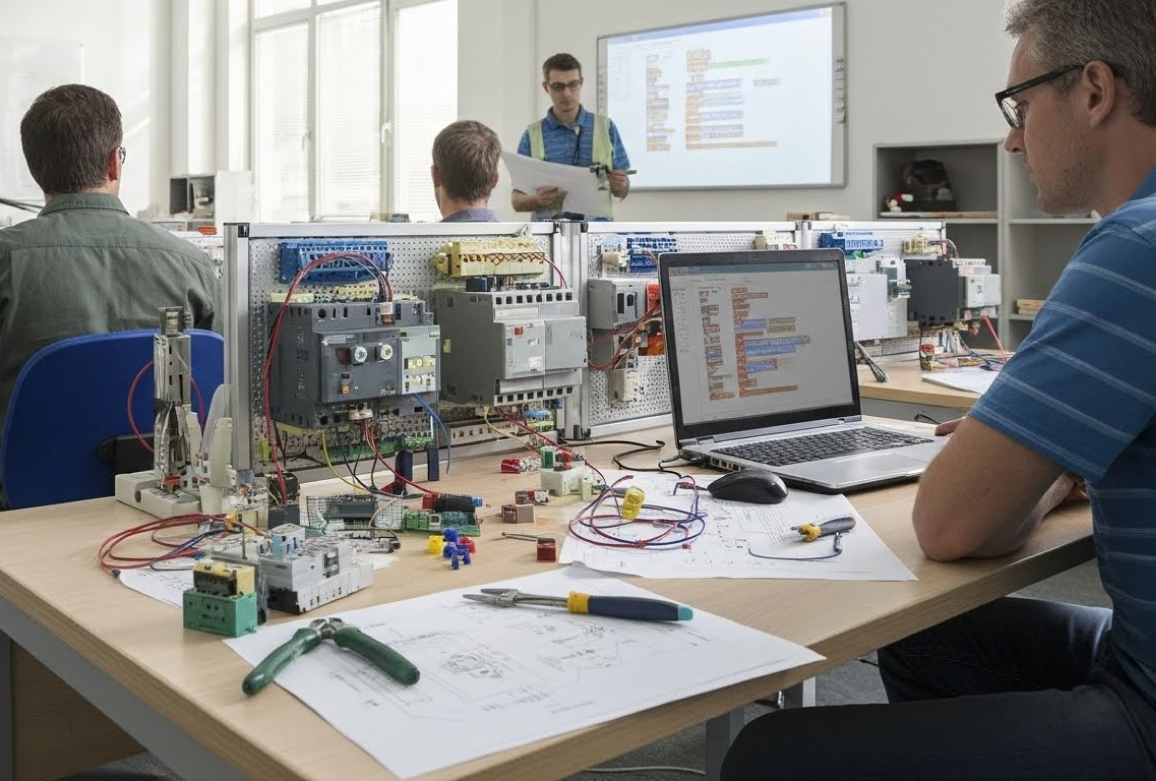
Learn all the concepts of developing automation systems using appropriate software with our PLC course. Get hands-on training in designing, monitoring, and controlling automation systems in small factories, large manufacturing plants, and processing industries. Build your skills and become a part of industrial automation by joining the PLC training in Qatar.
Summary of PLC and SCADA Training
PLC SCADA training is designed to equip the participants with theoretical knowledge and practical skills in control and automation. The PLC classes provide training in all the main PLA and SCADA software tools, and prepare the trainees to face the real challenges in the industry. You will acquire proficiency in PLC programming and the major PLC brands.
The objective of the course is to train the participants to become experts in programming PLCs and configuring SCADA systems. The PLC training courses also aim to provide knowledge to take care of the hardware issues and troubleshoot PLC programs.
You will learn to design and develop SCADA screens and to apply wiring concepts and industrial sensors in automation systems.
In-Depth Course Syllabus For PLC and SCADA Course
The syllabus of the PLC programming certification course includes:
Have an overview of what industrial automation is, its importance, and the various types.
Understand what a PLC is and its uses. Know the basics of its hardware.
Know what SCADA is and study its components.
Study the basics of communication and safety in industrial automation.
Understand the main components of PLC architecture, including the CPU, input modules, output modules, interface, and memory.
Study in detail the three types of PLC: compact, modular, and distributed.
Learn about the input field devices, including the push buttons, sensors, and limit switches.
Know the output field devices such as motors, heaters, relays, and valves.
Learn about timers, counters, basic logic gates, and alarms in Ladder Logic programming
Study basic blocks, PID blocks, function blocks, mathematical blocks, and comparison blocks in the Function Block Diagram
Understand the steps, actions, and sequences in the Sequential Function Chart
Discover PID control programming and communication-based programming. Find out how to work with analog inputs and outputs
Learn about handling complex logic in Structured Text
Get trained in wiring, connecting the hardware components like switches, sensors, and motors
Practical session in testing codes with different languages
Hands-on training in diagnosing and troubleshooting issues with real exercises and projects
Find out how to integrate PLC with other devices with practical sessions
Learn how to write programs and test them practically
Understand the core components, like sensors, used for gathering data, like temperature and pressure.
Learn about the communication infrastructure used for linking the field devices and the system
Study the remote terminal units, the microprocessors, and the master terminal unit connecting the HMI and the remote terminal units.
Know HMI, the software used for collecting data.
Find out how to select the appropriate hardware and the suitable SCADA software
Learn how to develop the architecture, define communication protocols, and design data flow.
Study the configuration of the system, creation of tags in SCADA, linking of tags to the addresses, and establish communication
Know the creation of the GUI and the control of the system.
Understand the addition of functionalities and the implementation of automation rules.
Understand the project requirements and then decide the hardware requirements
Find out how to create an appealing UI and UX design, how to design the architecture, and how to create the right scenarios
Learn about the development of a working model for transforming a design into a system
Study code writing, connecting HMI to PLC, setting up alarms, and configuring data tags.
Know the testing methods to detect bugs and fix them in the early stages.
Understand the communication protocols and the networking architecture
Find out how to acquire data using SCADA and log it using PLC and RTU. Learn the creation of SCADA programs and script them.
Acquire skills in maintaining SCADA systems and troubleshooting problems in SCADA systems and communication networks.
Discover how to meet the cybersecurity challenges, address IP, and exchange data between devices.
Essential Skills You Will Acquire
- After completing the PLC SCADA course, you will gain skills in writing and editing PLC programs
- Acquire proficiency in SCADA development with PLC automation training
- Become an expert in working with protocols for configuring PLC and SCADA communication
- Gain skills in diagnosing and troubleshooting hardware issues, wiring faults, and problems in communication
- Build competence in developing an HMI interface.
Tools and Software Included
Tools and software included in PLC automation training are:
- PLC programming software
- SCADA development tools
- Tools for communication and networking
- Simulation tools
- Documentation tools and
- HMI configuration software
Career Scope in PLC and SCADA Design Course
Industrial automation is gaining a lot of popularity worldwide. This has increased the global demand for professionals with technical knowledge in PLC and SCADA. So, PLC training courses have a huge career scope. You are assured of excellent career growth and competitive salaries after completing the PLC programming course.
After completing the PLC programming course, you can pursue diverse roles, including PLC programmer, SCADA operator, system integrator, SCADA engineer, project engineer, and process control engineer. The industries that use PLC and SCADA experts are the oil and gas industries, the automotive industries, food processing companies, pharmaceutical industries, and manufacturing sectors.
Who Can Enroll?
Professional engineers, like maintenance engineers, instrumentation engineers, production supervisors, and electrical technicians, who want to upskill themselves, can enroll in the course. Fresh engineers and diploma holders who want to launch their career as PLC and SCADA technicians can join the PLC course. Anyone interested in industrial automation can enroll in the PLC training in Qatar.
Why Choose Us?
Engineering Design Qatar is one of the top institutes providing short-term technical courses designed for working professionals. The highlights of their courses are:
- Comprehensive syllabus including all concepts
- Experienced trainers with expert knowledge
- Flexible schedules
- Career guidance
- Globally recognized certificate
Enroll NOW to build your career in industrial automation.
Fill in the details in the online application form and submit it with the essential documents. The process is quite simple, but if you have any doubts, you can contact the support team.
FAQ
The duration of the course may vary from three weeks to three months, depending on the syllabus.
The PLC courses help you enhance your career. The participants will be able to improve the efficiency and promote the safety of their workplace with the skills gained from the course.
No, it is not difficult to learn. It is easier to learn than traditional programming. If you have a background in electrical or electronic fields, you will find the course easy.
Yes, we offer a combined training. The course covers both PLC programming and SCADA development.
The software you will learn includes PLC programming software, SCADA development software, and simulation software.
The oil and gas industries, power generation plants, manufacturing industries, construction sector, food packaging industry, and process plants hire PLC professionals in Qatar.
Ratings & Reviews
4.5
Rated 4 out of 1 Rating
Featured review
It is an excellent course for both beginners and professionals. The trainers explained the concepts with real examples. This was very useful in meeting the job challenges with confidence.
I am a fresh electrical engineering graduate. I wasn’t sure about my future career. The PLC SCADA course was an eye-opener. It helped me launch my career in the PLC industry.
The PLC training course from Engineering Design Qatar was very useful. I would recommend it to anyone who wants to enter industrial automation.
The practical training and the job-oriented syllabus helped me get a job in the automation industry.