Overview
Firefighting design training is designed to provide skills in designing precise fire protection, fire suppression, and fire prevention systems. Master the art of designing firefighting systems and layout planning with the practical training provided in the course. Join the fire alarm system design course to protect lives and properties by creating the best designs.
Summary of Firefighting Design
Certified firefighter training course from Engineering Design Qatar is a specialized course with a comprehensive syllabus covering all essential concepts needed for designing all types of fire suppression systems, including sprinkler systems, pump rooms, alarm systems, hydrant networks, and others.
The main objective of the firefighting design course is to help the trainees understand the behavior of fire, develop appropriate firefighting designs to suit the requirements of the building, and select the right firefighting equipment.
You will learn all about fire protection systems and fire science, starting from fundamentals with firefighting training in Qatar, and the selection of all suppression equipment.
In-Depth Course Syllabus for Firefighting Design Course
The firefighting system design course covers the following topics in its syllabus:
Have an overview of the basics of fire science, fire hazards, and the importance of fire protection designs in buildings.
Know the common causes of fire in residential, commercial, and industrial facilities and learn how to identify high-risk areas.
Understand the fundamentals of active and passive fire protection systems
Understand the five classifications of fires: A, B, C, D, and K/F
Study the codes and standards to be complied with.
Become familiar with water-based firefighting systems, including the hydrant system, sprinkler system, water mist system, and fire hose reel system
Learn about gas-based fire suppression systems, like the clean agent system and the CO2 system
Study foam-based firefighting systems, such as foam sprinkler systems and high-expansion foam systems.
Know dry chemical powder-based systems, which are used for special purposes like electrical fires and fires caused by flammable liquids.
Have an overview of fire alarm systems used for detecting fires.
Know what a sprinkler system is and its types, including wet, dry, and deluge, and its key components, such as sprinkler heads, fire pump, pressure gauge, and checking valve.
Find out how to design a sprinkler spacing for light, ordinary, and extra hazards
Learn about the formula used for hydraulic design for all types of hazards. Understand how to make hydraulic calculations
Study the sizing of the pipes and the determination of water supply requirements. Know the preparation of layouts.
Study the types of standpipe systems, including Class I, Class II, and Class III systems. Know the types of standpipes, such as automatic, manual, wet, dry, etc.
Understand the design criteria to be followed. Find out how to calculate the required pressure, the required flow, and the number of standpipes required.
Learn about standpipe placement and planning its layout.
Find out how to test and commission standpipes using different methods like hydrostatic pressure test, pump performance test, and FDIC flow test.
Discover the types of fire pumps and the components of a fire pump system, like the main fire pump, pressure switches, flow meter, pressure gauges, all types of valves, and the pump controller.
Study the methods and formulae used for calculating pump pressure, friction loss, and elevation loss.
Find out the design of the jockey pump, suction pump, and their sizing.
Understand the design of the pump room, the pump controller, and tanks.
Become familiar with the types and components of a fire alarm system, including the detection devices, auxiliary components, notification devices, and initiation components.
Understand the step-by-step process of fire alarm system design, involving determining the requirements, selecting the devices, and designing manual call points design
Learn about the spacing and coverage of smoke detectors, speakers, sounders, and heat detectors in fire alarm system design
Study the wiring design in conventional and addressable zones. Know the types of cables and how to select the right one.
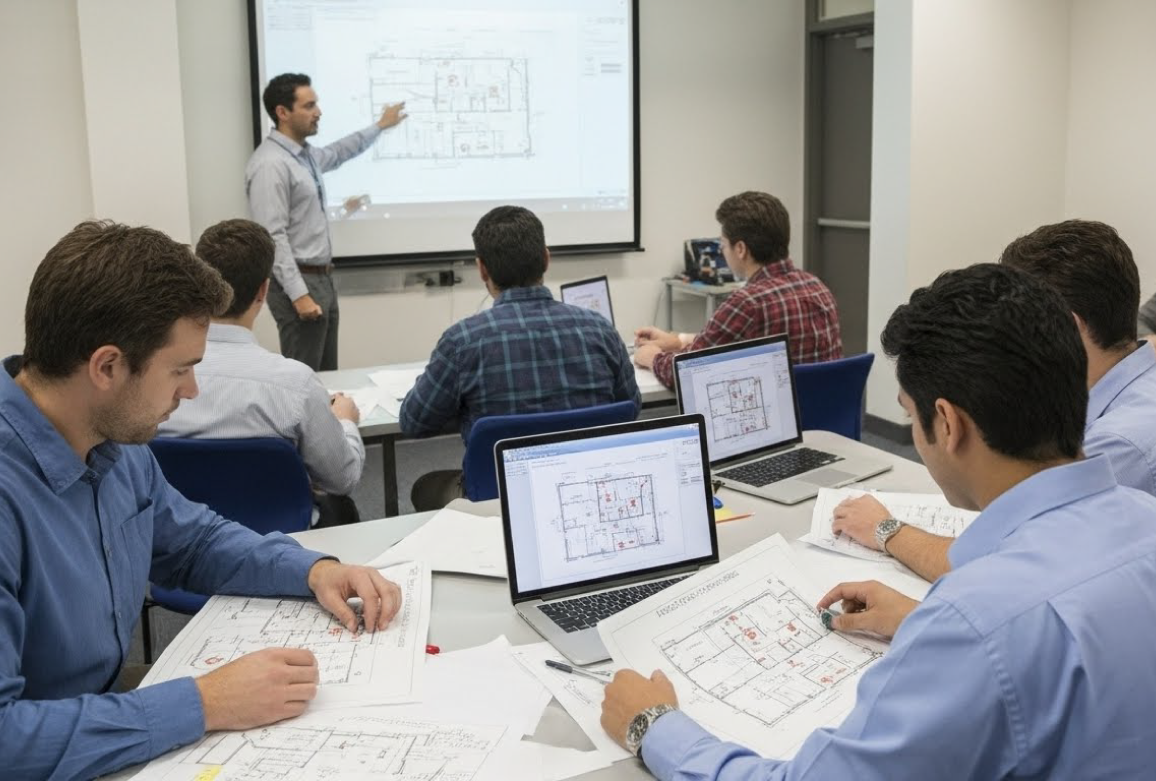
Practical training with real examples
Essential Skills You Will Acquire
After completing the fire alarm design course, you will gain the technical knowledge and skills needed to design fire protection and suppression systems. Gain an in-depth knowledge of the codes and standards with the fire alarm engineer course. Become proficient in the usage of the appropriate software tools and in making hydraulic calculations.
Tools and Software Included
The tools and software included in the fire safety engineering course are:
- AutoCAD for creating layouts
- Software tools for pump selection and hydraulic calculation
- Revit MEP for creating models
- Excel for creating templates and markup tools for reviews and comments
Career Scope In Fire Fighting Design Course
The demand for professionals with skills in firefighting design is high because residential, commercial, and industrial complexes require an effective fire protection design. So, you can pursue a career in fire protection system design without any second thoughts. Moreover, you are assured of a huge jump in your career after completing firefighting training.
You can pursue a wide variety of roles, such as a fire protection system designer, a firefighting system engineer, a fire safety manager, a fire safety consultant, a fire alarm designer, a fire alarm technician, and many more.
The industries where firefighting designers are in demand are MEP companies, construction firms, oil & gas industries, firefighting component manufacturers, and government projects.
Who Can Enroll?
- The firefighting training in Qatar is for professional mechanical and electrical engineers who want to specialize in fire suppression design.
- Existing firefighting engineers and technicians who want to upgrade their skills and advance their careers can enroll in fire firefighting course in Qatar.
- Fresh graduates and diploma holders who want to start their career in fire suppression design can join the course.
- Engineers and technicians in other sectors who want to switch their careers can also enroll.
Why Choose Us?
Engineering Design Qatar is a trustworthy institute providing short-term technical courses to boost the skills of working professionals. You should join their fire alarm system training because of its:
- Comprehensive syllabus covering both practical and theoretical aspects of firefighting design.
- Experienced trainers with experience and expertise
- Flexible schedules to suit working professionals
- Placement support and career guidance
- A certificate with global recognition
Join our firefighting system design course to build a career in fire protection and get job satisfaction saving lives.
Apply online on the official website. Submit the essential documents along with it. If you have any doubts, contact the support team.
FAQ
The course equips participants with the skills needed to design firefighting systems. It teaches about the selection of equipment, following codes, and hydraulic calculations.
You will gain theoretical knowledge and practical skills in creating code-compliant firefighting systems for commercial, residential, and industrial settings.
Fire-fighting training teaches you how to suppress and control fire. Fire alarm training teaches you how to detect fire early, alert occupants, and prevent fire.
Firefighting is one of the important sectors in MEP. So, this course will enhance your profile and take your MEP career to the next level.
The designs recognized by Qatar Civil Defense if those designs satisfy the criteria of the defense board.
Ratings & Reviews
4.5
Rated 4 out of 1 Rating
Featured review
I loved the training, especially the practical training with real project examples. It is an amazing course for anyone who wants to enter the firefighting field.
I was a firefighting technician. The course taught me how to use software tools to design fire protection systems. I can design layouts and make accurate calculations with lots of confidence.
It was an excellent course. Although I was a fresher, the instructors explained the concepts clearly. It's a highly recommended course.
It is the best course for everyone, including freshers and experienced professionals. I landed a job as a firefighting design engineer in just a few weeks after completing the course.